
Writing in response to layoffs at the Texas Tribune in 2023, CalMatters CEO Neil Chase said, “Nonprofit is a tax status, not a business model.” His point was that just because an organization is a nonprofit, it is still subject to regular business pressures. Whether one uses “tax status” or “business model,” this is ultimately a reductive description of how a business is structured — for- or not-for-profit — that doesn’t actually tell us much about the quality or impact of the work. At Impact Architects, we think this misses the point, namely, what motivates an organization?
In our ecosystem assessments and our day-to-day work with newsrooms, we see mission-driven nonprofit organizations that are doing deep community engagement and reporting, AND we find many for-profit, independently owned and operated organizations that are also mission-driven and deeply serve their community. And in some communities, we find legacy publications that are owned and operated by hedge funds or large corporations that might be doing basic reporting, but that are often simply republishing wire content online, without much community engagement.
We’ve struggled to adequately capture this nuanced reality in our ecosystem assessments, where we’ve generally categorized media based on tax structure — 501(c)3 nonprofit or for-profit. In our more recent work (see pg. 20 here), we’ve distinguished between independently owned and operated for-profit media and media that is owned by a hedge fund or chain, particularly when the owners are headquartered out of state. However, we realize that this categorization is imperfect. For example, in Arizona, Wick Communications owns twelve newspapers across the state, as well as papers in nine other states. Generally, we would classify this as a for-profit with corporate ownership. However, through interviews with local stakeholders, we learned that these papers have considerable local trust and are viewed as doing solid local reporting in service of their communities.
As we’ve noodled on how to incorporate examples like Wick papers into our ecosystem framework, I keep coming back to the simple idea of incentive structure as a better method of categorization: Who or what is a news organization incentivized to serve?
Rather than working within the confines of the tax code, we propose a new model that includes three incentive structures — along a continuum — to help categorize news organizations.
Community-driven: Mission driven organizations are incentivized to meet community information needs, engaging with them where they are, in the form and format they prefer. They need to generate enough revenue to cover costs, and this revenue can be through a mix of philanthropic, individual members/donors, and earned revenue.
Profit-driven: For-profit organizations that have as their primary goal generating profit — meaning they will prioritize cost-savings and revenue maximization above all. At its most extreme, this can lead to AI slop sites and pink slime, where the content itself is not a priority, only eyeballs to maximize ad revenue.
Hybrid community-profit: For-profit organizations that are mission driven and have a goal of generating profit while also serving their community/ies. In these cases, simply covering costs would not be considered a success.
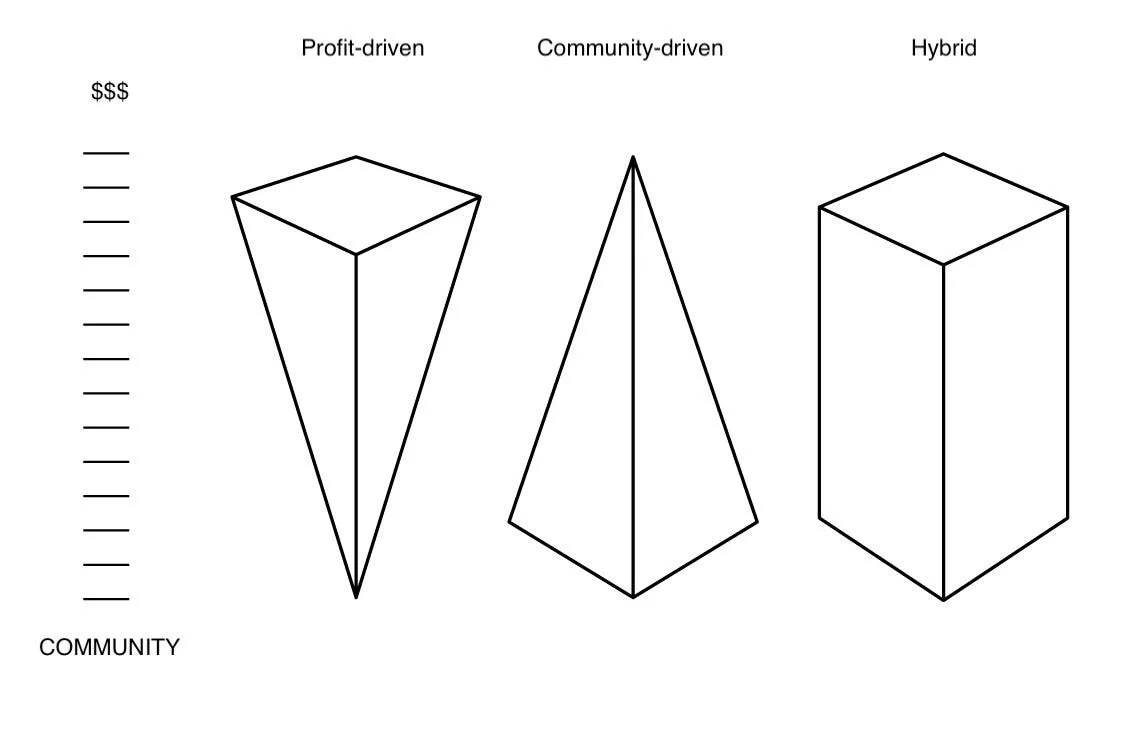
This image is an adaptation of designer Joey Roth’s Charlatan, Martyr, Hustler poster, which I see regularly in my local coffee shop.
It is important to note here that we’re talking about the organizational structure and not the people inside of the organization. We know there are plenty of journalists, editors, leaders, business and operations people, and more working inside profit-driven news organizations that have deep community commitment, and at an individual level are working hard to serve their community. However, as journalist Megan Greenwell documents in her new book, Bad Company, private equity is devastating the media. Dedicated, intrepid reporters and editors are still working within the confines of their organizational structure and oftentimes do not have ultimate decision-making power, especially about audience engagement and distribution strategies, as well as story selection and editorial planning.
Why is this important?
As there are more and more philanthropic dollars being invested in local news and information producers, too often decision-making about where to invest is relying on concepts of “news deserts” — whether or not there is any information available — rather than the incentive structure of the information providers present. In general, we think it is critical to have organizations that fall along the continuum from community-driven to hybrid in a community to adequately meet local news and information needs.
This reframing provides a different framework for understanding a local media landscape. As funders enter the space, being able to parse local information providers’ incentive structures will surface new and different assets and infrastructure that might already exist, as well as their relative value to the community, while also identifying gaps in the types of news organizations that are present. This can help with the difficult job of deciding who gets investment for what. And we think this reframe actually opens up more possibilities for including community-driven for-profit and hybrid organizations into the mix, while clearly understanding when there are structures and institutions in place that are not contributing to long-term social impact, and in the worst case might actually be contributing to pink slime, AI slop, and the spread of mis- and disinformation.
As we continue to map and make sense of the local news landscape, we believe shifting the lens from tax status to incentive structure offers a more accurate and equitable way to assess a newsroom’s function in its community. By examining who or what an organization is incentivized to serve, we can better distinguish between those producing journalism as a civic good and those who are extractive. This perspective isn’t absolute, and doesn’t dismiss traditional categorizations, but it does challenge us to look deeper and ask better questions, at a time when local journalism is both under threat and ripe for reinvention.