
In 2020, three funders came to us and said, “we all fund local news ‘ecosystems,’ but that means something different to each of us.” We spent the next six months, with the support of Democracy Fund, Knight Foundation, and Google News Initiative, digging into the research and literature, finding publicly available and free data sources. We built and applied the resulting framework to eight ecosystems across the U.S. The goal of this framework was then, and continues to be, to create a standardized way to assess the health of a local news ecosystem, and to compare across ecosystems and assess change over time.
Since then, we’ve applied the framework a number of times, and we’ve been thrilled to hear about communities using the framework to document the health of their own local news ecosystems. And each time we apply the framework, we learn something new, make tweaks, and find new data sources.
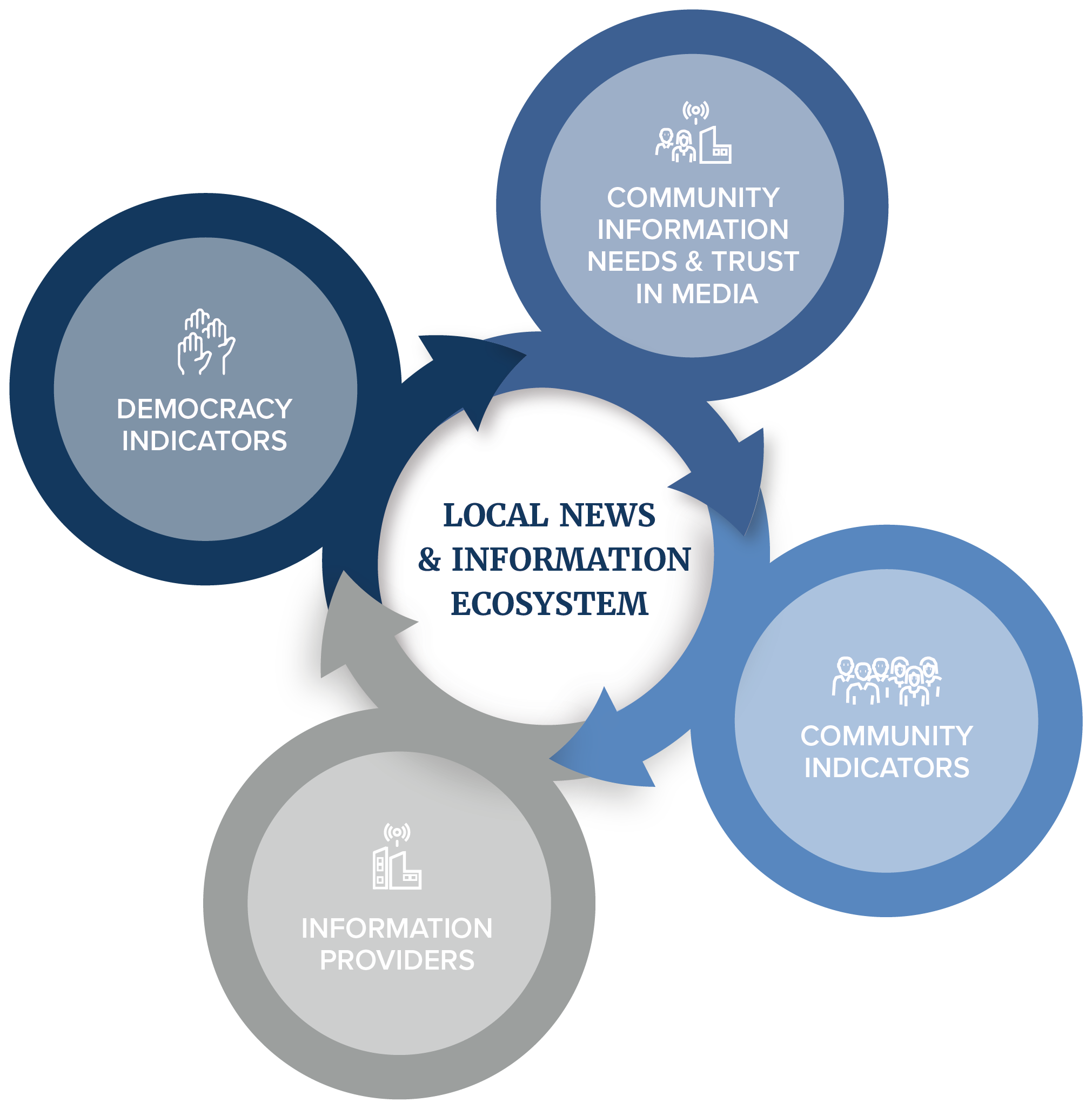
The Local News and Information Ecosystems Assessment framework now includes indicators to capture civic engagement and democracy. Graphic design for the report by Delphine Wibaux, Del&Co.com
This year, in partnership with Democracy Fund, we had the opportunity to do a major upgrade to the framework. We updated our literature review, focusing on what we know about the connections between local news, civic engagement, and democracy. Based on what we learned, we updated the framework to include four categories of local news ecosystems: Community, Information Providers, Community Information Needs and Trust in News, and the new area of Civic Engagement and Democracy. These categories include a total of more than 85 indicators.
To learn more about the methodology of this report, and how and why we included civic engagement indicators, head here.
We then applied this framework to ten ecosystems–eight states and two cities. In some cases like New Jersey, an ecosystem has had a decade (or more) of intentional funding, organizing among news providers, advocates, funders, and others, and activity to strengthen the ecosystem. In other cases, like Arizona, on-the-ground actors are in the early stages of building networks, mobilizing resources, and organizing the ecosystem.
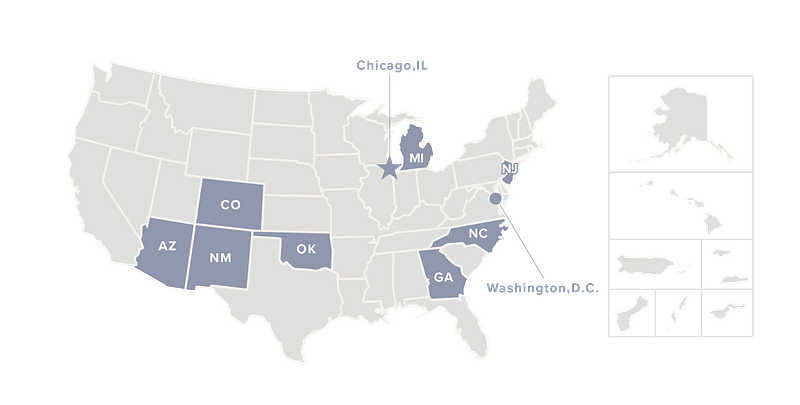
In this project, we have applied the Local News and Information Ecosystem Assessment framework to ten ecosystems: Arizona; Chicago, IL; Colorado; Georgia; Michigan, as well as Detroit; New Jersey; New Mexico; North Carolina; Oklahoma; and Washington, D.C.
By selecting a diverse array of ecosystems, we were able to test assumptions about the importance of local news and information across different communities and identify themes that emerge both with and across different divides, be it rural and urban, income, linguistic communities, or others. We also hope the diversity of ecosystems can provide relevant examples about different opportunities and points of entry for local funders to support the production of and access to local news and information in support of community health and civic engagement.
While previously, we framed our learning using a lens of “health,” what is clear after implementing this framework several times now is that, rather than healthy vs. unhealthy local news ecosystems, it’s more accurate to think of the strength of local news and information ecosystems on a continuum, with different ecosystems having different constellations of strengths and areas of opportunity within and across a geography. In this latest iteration of the report, we’ve clustered ecosystems into four broad groups: strong, emergent, opportunity with bright spots, and under-resourced, based on their strength within the four categories of local news ecosystems.
Across all ecosystems, we noted some promising trends.
Collaboration
Cross-sector collaboration: As surfaced in research by Sarah Stonbely and Hanna Siemaszko for the Center for Collaborative Media, we found cross-sector collaboration among advocacy organizations and journalism organizations in many ecosystems, typically in order to bring in different kinds of expertise and to reach different audiences. For example, in the wake of Hurricane Helene, Enlace Latino has been sharing critical information with Spanish speaking residents of North Carolina, including translating official information and resources into Spanish and sharing information via WhatsApp and its newsletters.
Sustainability collaboration: In addition to collaborations for editorial purposes and audience engagement, we found multiple examples of collaborations aimed at generating revenue and/or lower costs for news organizations.
Newsrooms servicing an ecosystem: Previous ecosystem assessments have noted that backbone institutions serve an important role for providing key infrastructure and resources for an ecosystem. In some ecosystems, we found that newsrooms, such as KOSU, a public radio station in Oklahoma City and Outlier Media in Detroit, have stepped into a leadership role in their respective ecosystems, serving many of the functions of a typical backbone organization.
Innovation to reach and engage communities that have historically been underrepresented and underserved by local journalism.
Direct engagement: News organizations are engaging directly with their audiences through SMS, text, WhatsApp, WeChat and other direct-to-consumer messaging channels, as well as soliciting feedback and questions from their communities via these channels.
Community information providers: In some communities, we found organizations that are not traditional journalism providing accurate, trusted information to residents. For example, the Documenters Network has members that are community organizations, such as the New Jersey Alliance for Immigrant Justice in Newark and coLAB Arts in New Brunswick, NJ.
Even with these promising trends, we found common challenges across ecosystems.
Uneven distribution of resources: There are uneven distribution of resources across a number of fractures, for example, rural areas are most lacking resources with regard to news and information. And news organizations serving communities with first-languages other than English are under-resourced.
Sustainable community-serving media: In many ecosystems, there is not adequate news by and for communities of color. This looks different in different ecosystems, but across the board we identified a lack of Spanish-language news sufficient to meet the needs of large and growing Spanish-speaking communities. We also noted that tribal and Indigenous-owned media face unique challenges, from tribal-ownership and press freedom issues to serving community members with intersectional identities.
Press freedom and information access: We noted a trend of decreasing access to information for journalists across ecosystems, including in Blue states like Colorado a bill to curb “abuse” of the Colorado Open Records Act (CORA) passed the statehouse but didn’t make it past the senate, and New Jersey, where in Spring of 2024, the legislature passed a bill that alters the Open Public Records Act (OPRA), the mechanism by which residents request and access government information.
We hope this work will spur ideas and investment in the ten ecosystems presented, as well as in others. We are currently wrapping up an assessment of the local news landscape in Wyoming, and hope to have the privilege to partner with more communities to do baseline assessments, document change over time, and identify needs and opportunities to strengthen the provision of and access to local news for all communities.