
Graphic design by Delphine Wibaux, Del&Co.com
Throughout the past year and in partnership with Democracy Fund, Impact Architects dove into 10 news and information ecosystems across the U.S., conducting interviews with local stakeholders and drawing on existing databases and quantitative data sources to help us get a baseline understanding of the state of the landscape in each location. To do this, we relied on the healthy news and information ecosystems framework we developed in 2020, with support from Democracy Fund, Knight Foundation, and Google News Initiative.
What’s changed in our approach since 2020
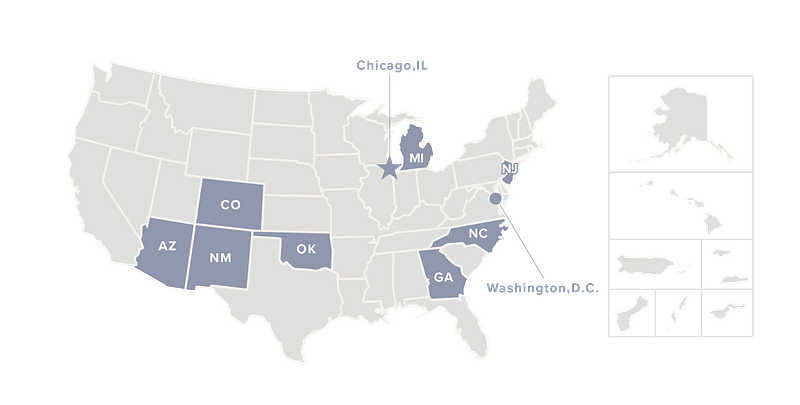
This project was the third iteration of the framework, but the first time we applied it to entire states (Arizona, Colorado, Georgia, Michigan, New Jersey, New Mexico, North Carolina, and Oklahoma) in addition to cities (Chicago and Washington, D.C.). Bolstered by Democracy Fund’s vision, this was also the first time we developed and included a set of democracy indicators, informed by research that has identified the relationship between local news and civic engagement. These indicators helped us explore the intersection of information ecosystems and key aspects of press freedom, information access, and challenges to democratic institutions like voting. This broader context also helped us better identify gaps in critical civic information infrastructure as well as challenges for news outlets. In Arizona, for example, a closer look at 2022 election and voting litigation helped us better understand the highly polarized environment in which information providers were producing election coverage and residents were casting their ballots.
Graphic design by Delphine Wibaux, Del&Co.com
Using publicly available data
Our research for this project relied almost entirely on publicly available data — one of our goals was to ensure the framework was accessible for stakeholders who might want to apply it to their own ecosystems. We searched the U.S. Press Freedom Tracker, considered data on civic engagement from the Harvard Cooperative Election Study, drew on Democracy Docket’s database of election and voting rights court cases, and included measurements of the difficulty or ease of voting in a state from the Cost of Voting Index. While some data was relatively easy to find, such as voter registration and turnout data from the 2022 midterm elections, other data required more manual research. To get a sense of transparency and information access in local governments, we explored a sample of county government websites for each state ecosystem, as well as the city government websites for Chicago and D.C., and recorded information about the availability and accessibility of public meeting materials, the amount of information available about local officials and decision-making bodies, and the number of unfilled positions in government. In some cases, we found that counties did not have websites at all, a particularly concerning phenomenon in counties with few or no news providers.
Measuring a news and information ecosystem is challenging, especially when it comes to measuring an entire state. Finding data sources for community information needs was particularly difficult. There is currently no regularly repeated, nationwide assessment of information needs, trust in news, and news consumption habits. While we were able to rely on the Gallup/Knight “American Views 2022: Part 2, Trust Media and Democracy” study for this project, that assessment (and others like it) is not regularly repeated, and data disaggregated by state or city is not publicly available. While some ecosystems in our report had recent information needs, trust, or other ecosystem assessments that we were able to draw from, this was not universal.
Read some of the top-level findings from our report.
Our challenges
One of the most challenging pieces of this research was trying to create a list of local news and information providers in each ecosystem that was as comprehensive as possible. To do this, we combined information from the 2023 State of Local News Project, the Corporation for Public Broadcasting, the National Federation of Community Broadcasters, local broadcast affiliate lists for national brands like ABC and public media like PBS and NPR, and community media databases created by the Center for Community Media (CCM) at the Craig Newmark Graduate School of Journalism at CUNY. We also learned of additional news and information providers from interviews with local stakeholders and from prior ecosystem research, and included those. Even so, we know we did not capture every outlet in each of the ten ecosystems. This is in part because ecosystems are always in flux — outlets have launched and closed throughout the past year, and we can only capture a snapshot in time. But another thing we noticed in conducting this research is that media by and for communities of color and non-traditional news sources like local blogs and newsletters are often left out of existing databases. CCM’s databases of Asian, Black, and Latino media were invaluable for identifying outlets that are geared towards those communities.
Local expertise
Conversations with local residents were crucial for helping us understand what news sources residents rely on — from local blogs like Prince of Petworth in D.C. to organizations that launched on Substack like 285 South in Metro Atlanta. And beyond filling in gaps in our list of information providers, local stakeholders helped us understand the state of each of the ecosystems on the ground. We asked them about strengths and challenges in the local news landscape, press freedom and information access, and civic engagement. We interviewed at least one working journalist as well as representatives from at least one local journalism funder, journalism backbone or support organization, and community organization in each ecosystem. In some ecosystems, there were no official journalism backbone institutions — organizations with the explicit goal of providing support in the form of (re)granting, training, and/or research for the entire information ecosystem — but we still spoke with individuals who have been working as unofficial ecosystem-builders. But we know we did not get to hear from everyone. We could only conduct a handful of interviews in each of the ten ecosystems.
We hope that this report, and our updated news and information ecosystem framework, will be useful to local information providers, news consumers, funders, and ecosystem-builders. We have a playbook first launched in 2021 for people to apply our approach to their own communities, which we’ll be updating later this year.
And we hope that this report will be a stepping stone for further research in these and other ecosystems. If you have ideas on where we should explore next or how our methodology can be updated, let us know!
