
In partnership with the Wyoming Local News Fund, in late 2024 Impact Architects released a report detailing the state of the local news and information ecosystem in Wyoming, using our local news and information ecosystem framework. As part of this project, we developed a survey for WY residents to better understand their news and information needs, consumption habits and preferences, and trust in local news, administered by the Wyoming Survey Analysis Center. This survey provided a wealth of information about what Wyomingites think about local news, which you can read about in the full report. Here we’re sharing some of the major findings, as represented in five charts.
Wyomingites look to their social circle for news about schools and education.
When asked what sources were most useful for finding news and information about a variety of topics, what Wyomingites selected for schools and education was perhaps the most interesting result. About two-thirds of Wyomingites cited friends, family, colleagues and acquaintances as one of the most useful sources of news and information for schools and education. (The next most frequently cited source was local news websites, at 52%.)
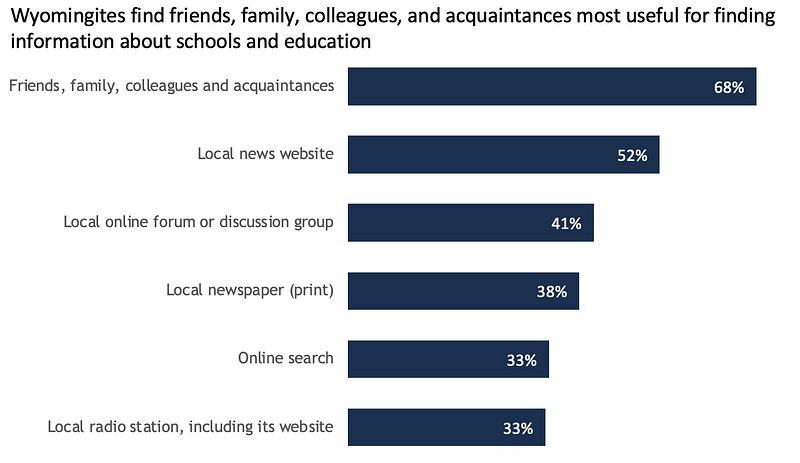
Note: Respondents could select more than one option, which is why the total exceeds 100%.
The only other topics in which more Wyomingites cited friends and family more than any other source were religion and local activities — both less “newsy” than schools and education. Additionally, the 68% mark was among the highest across all combinations of sources and topics. For instance, the most frequently cited useful source for crime and public safety was local news websites, at 56%. One potential follow-up from this finding could be to research further what kinds of information about schools and education people go to their social circles for. Another action item could be to analyze the state of education journalism in Wyoming to identify potential investment opportunities to better meet local needs.
Online search is more useful than local news websites for key topics.
Another insight gained from the question about the relative utility of sources pertains to local news websites compared to online search. There was a split between how often these were selected as useful, and there are clues in the topics as to why that might be. The chart below displays the different frequency at which each source was selected as useful, excluding those in which the difference was less than 10 percentage points or in which neither was cited by more than 25% of respondents.
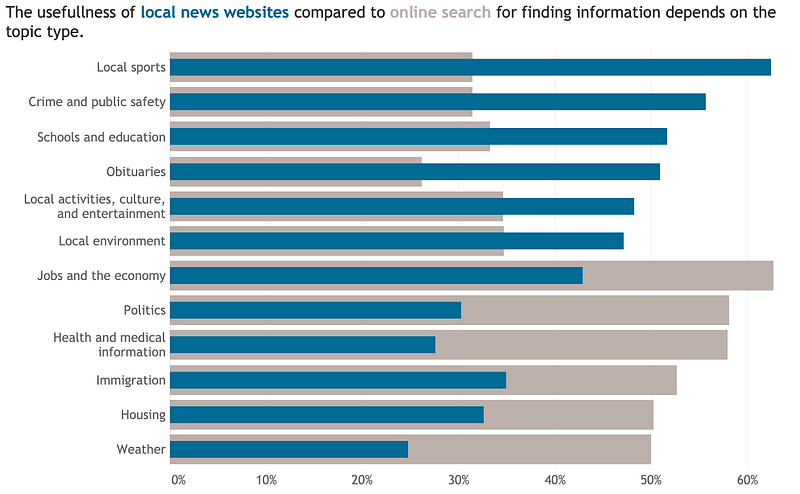
Wyomingites find local news websites as more useful for strictly local, “newsy” matters such crime and public safety, local environment, local sports, and schools and education. Online search, however, wins out for topics that, while “newsy,” also have a utilitarian element, such as housing (including finding and paying for housing), jobs and the economy (including for finding jobs, financial decisions, and support), and health and medical information (including finding and paying for care). It also includes topics with a national bend, such as immigration and politics. There could be an opportunity for local news in Wyoming to be more oriented toward supporting residents in identifying resources in areas such as housing, work, and health.
Wyomingites seek accountability, perspective, and solutions from journalists.
Exploring solutions, holding leaders accountable for their actions, and presenting different perspectives are all roles for news that Wyomingites say are quite important; they’re also ones in which there’s a gap between the importance and perceived performance. The chart below displays the three topics in which there’s an at least 20 percentage point gap between perceived performance and importance of a variety of roles for local news. The percentages for perceived performance are aggregated from those who responded fair, good, or very good, and the importance datapoint is an aggregation of those who said it is somewhat important, important, or very important.
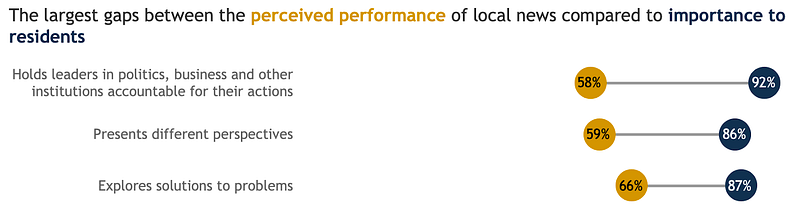
The three roles with the biggest performance to importance gaps are each a little bit different. Holding leaders accountable is mostly about what local news does, and it is one of the core traits of journalism with impact because it can often lead to discernable change. Presenting different perspectives is more about how local news works, and it can relate to building trust through fairness. Finally, exploring solutions to problems is primarily about potential outcomes. It differs from holding leaders accountable because it can have an impact on individuals and communities without institutional change. Based on this, newsrooms in Wyoming can consider either putting more energy toward what’s most important to Wyoming residents or finding new ways to showcase the work they’re already doing in these areas.
Younger residents prefer getting their news from social media.
We asked Wyoming residents which form of media they prefer to get their local news and information. That younger respondents between 18 and 44 prefer social media more than those 45 and older is not surprising, but the size of the gap illustrates just how different the preferences between these two age cohorts are.
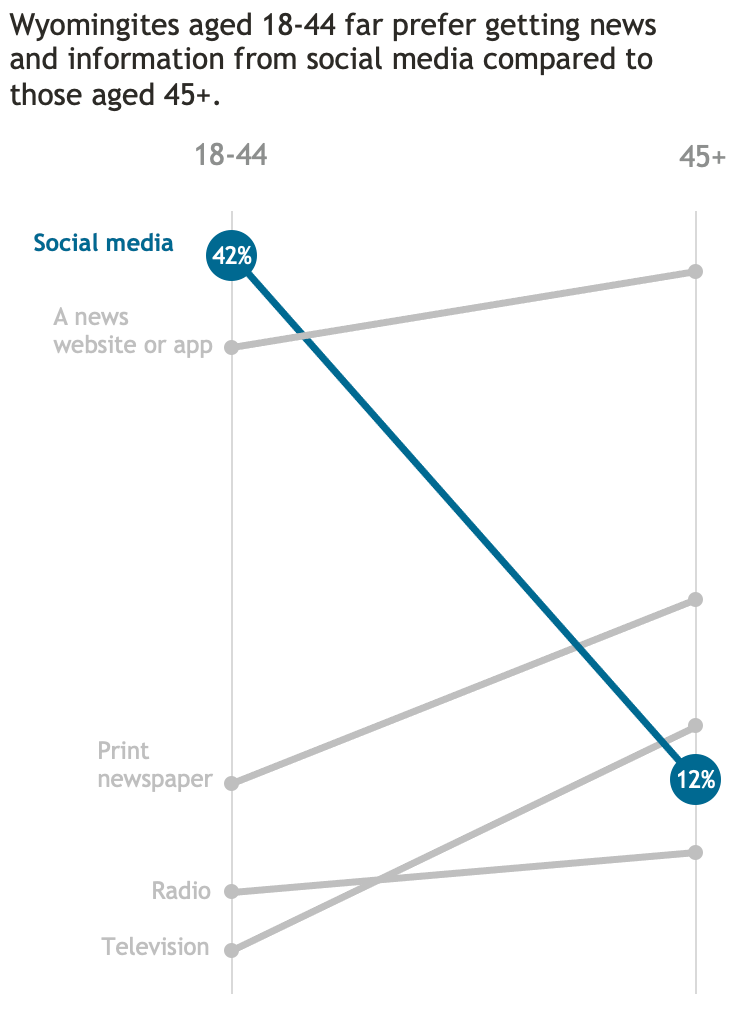
Findings from the Pew Research Center indicate that over half (54%) of adults in the U.S. get news from social media at least sometimes. This result, however, reveals just how much younger Wyomingites prefer social media compared to older ones. For those aged 45 or over, social media is not even the second or third most common preference. While less a revelation and more an affirmation, the finding highlights the need for news organizations to consider alternative methods for distributing their content. To explore how often these age cohorts go to different sources, visit this interactive dashboard.
Community engagement is more important than social media presence.
Because social media is such a go-to for younger Wyomingites, it’s not surprising that two-thirds of residents say that it is at least somewhat important that journalists be active on social media. It is surprising, however, how that compares to other activities. Over 90% of Wyomingites say that it’s important for journalists to be personally engaged in the local community and to understand its history.
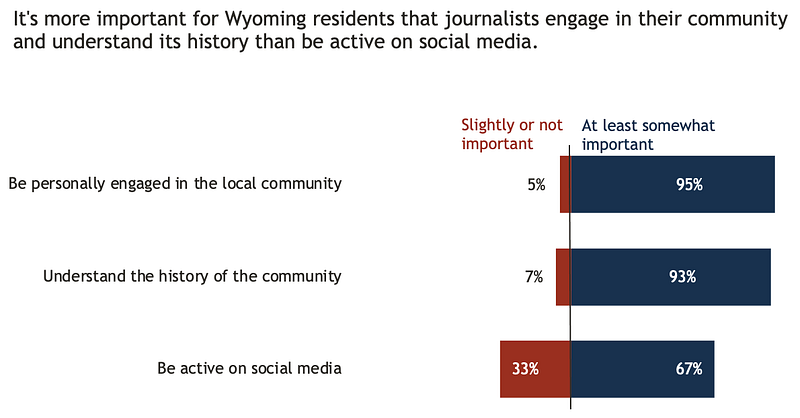
Social media is a common place to get local news, and its prevalence will likely only grow. But that doesn’t mean being present and engaged in community is any less important.
We look forward to seeing how these insights are turned into action in Wyoming. And if you’re someone hungry for insights yourself, we’d love to hear from you. Impact Architects can assist with research, survey design and analysis, as well as data analysis and visualization. Check out our new services page here.