
IA Ecosystem products
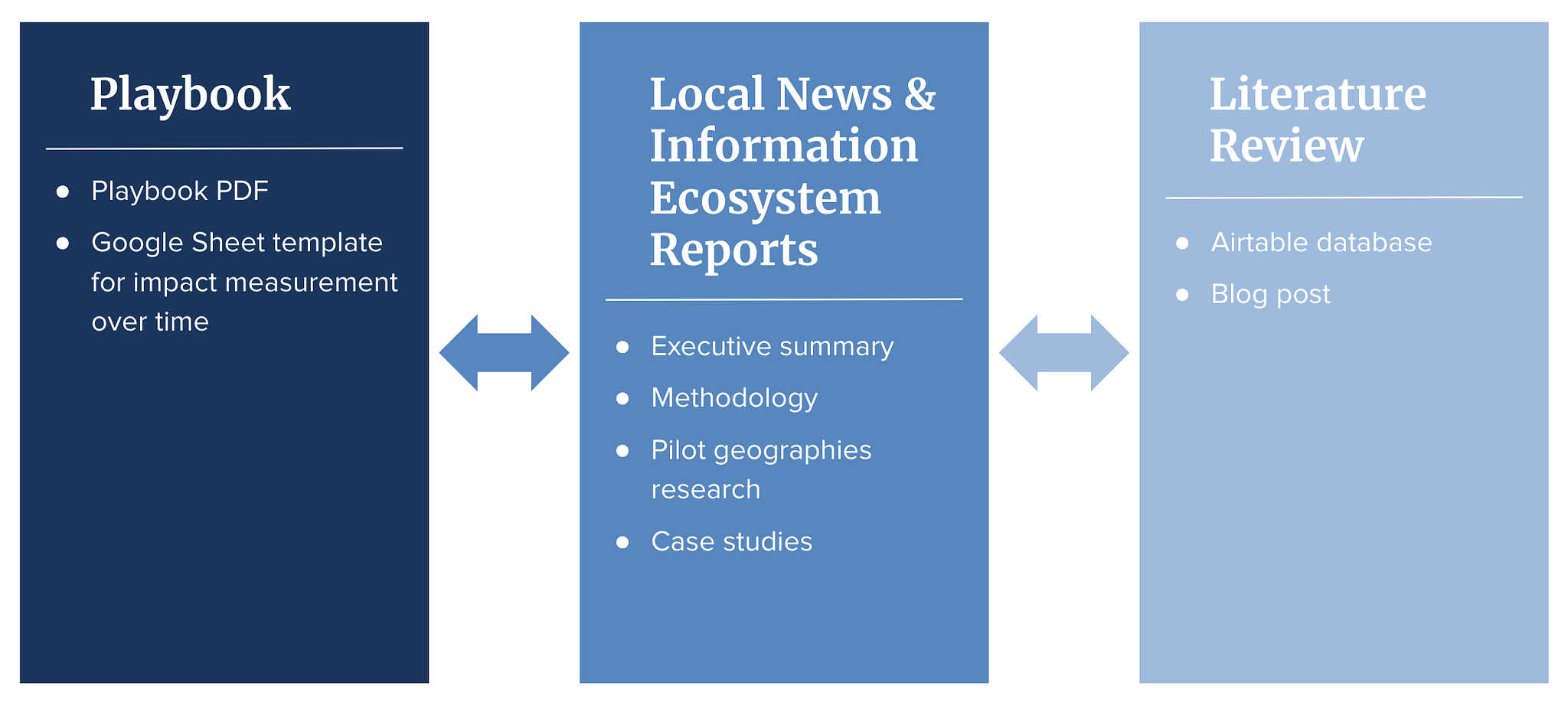
Following the publication of our 2024 Local News & Information Ecosystem work, we’re excited to share an updated Local News & Information Ecosystem Playbook and accompanying Workbook. We hope that this playbook will allow community members — whether they are journalists, researchers, or other local news enthusiasts — to measure their local news ecosystems over time in order to identify opportunities and set goals for strengthening the ecosystem.
The first version of this playbook was published in 2021, with support from Democracy Fund, Google News Initiative, and Knight Foundation. The goal was to create a detailed set of guidelines for taking baseline measurements of a news and information ecosystem, using the same approach Impact Architects used to explore the news and information landscape in eight cities in the same year, and eight Knight resident cities in 2023. With the help of an editable workbook (in the form of a Google Sheet), users could track their ecosystem’s progress over time, repeating the measurement process year to year.
This updated version incorporates new metrics we used in our 2024 analyses of 11 different cities and states across the U.S. (you can read our reports on those news and information ecosystems here). In particular, we focused more on measures of civic engagement and democracy, adding metrics for individual participation, accessibility of local government information, challenges to voting rights and access, and press freedom — in addition to the voting and registration numbers included in the first version of the playbook. These and other community indicators will provide users with a more holistic view of their ecosystem, allowing them to see how these factors are connected to and impacted by the state of local news in their community.
We’ve also updated our process for identifying news and information providers in an ecosystem, pointing playbook users to a variety of existing databases and encouraging them to lean on community stakeholders to fill in the gaps. We know that existing resources typically don’t account for every news and information provider in a community, but local broadcast and press association membership lists, as well as interviews or focus groups with local residents, can help round out the list.
As in the previous iteration of the playbook, we relied on publicly available data sources to help increase the accessibility of the baselining and measurement process. However, this approach means that collecting quantitative data on information needs in a local news ecosystem can be challenging since there are currently no nationally representative, publicly available surveys of information needs, access, and trust in news conducted on an annual basis. While conducting a representative survey of residents of your local ecosystem is a great way to collect rich data on these topics (see how we did this in our Wyoming Local News & Information Ecosystem report), we know not everyone has the time and resources to run a survey, and we’ve provided other recommendations for learning about information needs, including having conversations with a wide range of residents in your community.
This playbook is intended to be a tool for everyone, whether or not you have experience researching local news ecosystems. We encourage you to explore the playbook, workbook, and ecosystem reports on the Ecosystems page of our site, and share what you’re learning with us if you implement the tools in your community.
