
How do you approach an impact report as a news organization? While you may jump to thinking about the end product, and the graphics to bring your impact report to life, it’s helpful to begin with your strategy. Because at its core, impact reporting for journalism is an exercise in storytelling. It requires pulling in various pieces of data and insights into what happened as a result of your work.
In our view at Impact Architects, an impact report should connect to your organization’s impact framework, which provides a clear, consistent structure for demonstrating your organization’s progress toward its goals. By outlining the connections between your outputs, or the work you produce, and the outcomes of that work, an impact framework can serve as a narrative thread that simplifies the process of communicating your organization’s story to stakeholders.
In a recent project, we worked with America Amplified for its Election 2024 initiative. Originally launched in 2019 to bring community engagement into reporting on the 2020 presidential election, their team hoped to better understand the real-world impact of stations’ work in the run-up to the 2024 election cycle. We began by defining what “impact” actually meant in the context of America Amplified, a complex initiative spanning 44 states and 53 newsrooms. And while quantitative metrics like website traffic or social media followers are helpful metrics to understand who newsrooms are reaching and how, often, the most profound impacts are qualitative: strengthened community relationships, increased civic participation, or a deeper understanding of local issues.
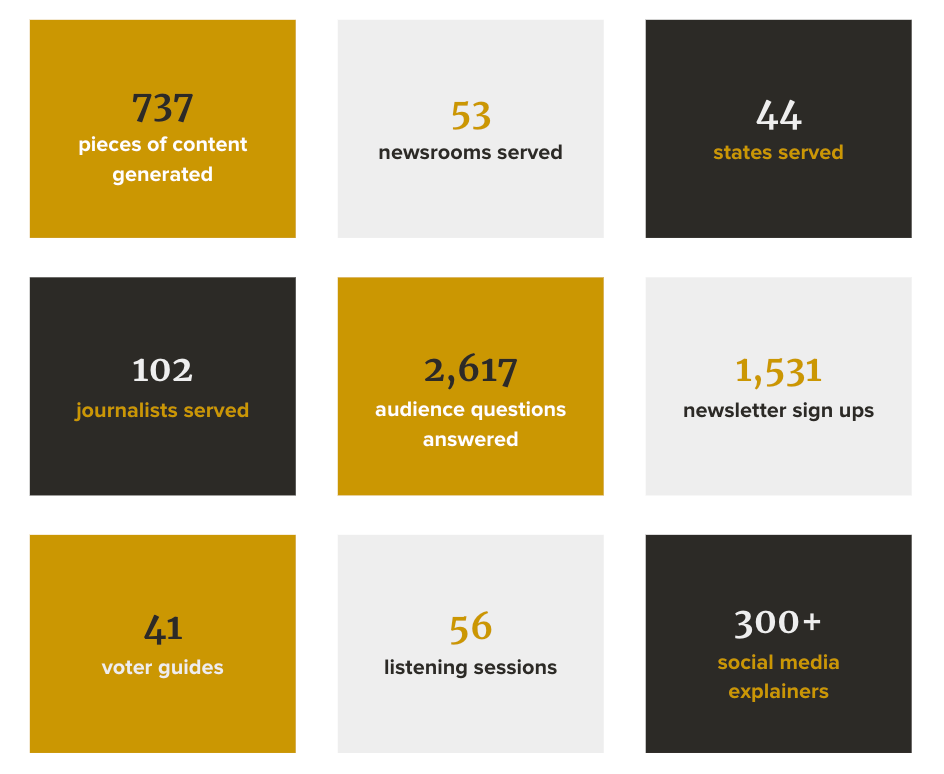
These concepts were the basis for our impact framework and qualitative IA Impact Tracker tool for America Amplified, which helped anchor our storytelling for an end-of-program impact report in late 2024. It allowed us to connect the diverse activities across 53 newsrooms to broader, shared goals. This framework provided a structured approach, making it easier to illustrate how specific events or activities, provided by newsrooms to the America Amplified Impact Tracker, contributed to larger outcomes like increased awareness of issues relating to the election, civic participation, and strengthened community engagement practices within the participating stations. It ultimately helped craft a compelling narrative to fit into broader reporting for America Amplified’s stakeholders, and also surfaced areas where we might want to make changes or be more effective in the future.
Through this process, we’ve developed five questions for those looking to use their qualitative impact tracking to build an impact report:
What specific impact are we trying to measure?Help clarify goals and define what “success” looks like, and let that definition of impact be expansive and include qualitative data that gives rich detail.
Who is our target audience for this report, and what do they need to know? Tailor the report to stakeholders like funders, community or audience members, or internal teams to keep it relevant and effective.
What data and evidence do we have to support our claims of impact? This focuses on gathering both quantitative and qualitative data, including audience feedback, community engagement metrics, and journalistic outcomes. This is where having a centralized place to gather and categorize that qualitative data, like an Impact Tracker, can be helpful for monitoring long-term impact and easily surfacing evidence for a report.
How can we tell a compelling story that connects our work to the impact?A clear impact framework makes storytelling easier, providing a cohesive narrative of your organization’s overall impact.
What lessons have we learned from this process, and how can we improve our reporting in the future? Use the process of collecting and writing an impact report, and the final product, as a tool for growth and development for your organization.
Read the America Amplified 2024 Impact Report, and check out these other resources for ideas on how to build your own: