
This is an abridged version of a keynote talk I gave in Lausanne, Switzerland in late 2025 at the launch of OurFrame, a nonprofit impact media company.
For nearly a century, journalism held a privileged position in public life. It was authoritative, consistent, and trusted — and the advertising-based business model that sustained it aligned neatly with what audiences expected. Then the internet arrived, people’s attention was split among nearly infinite digital information sources, and the the business model that we thought served journalism proved to actually serve advertisers.
Journalism and the advertising industry no longer had aligned objectives with the arrival of the internet.
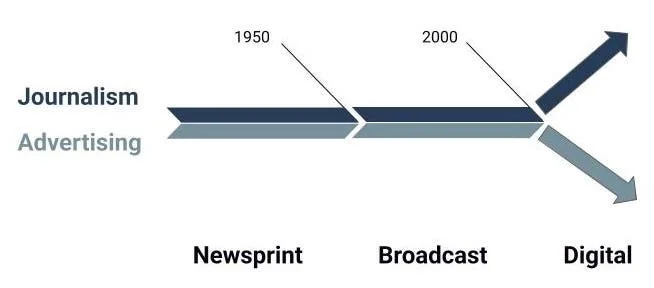
The instinct inside most newsrooms has been to ask: How do we get audiences to come back to us? I think that’s the wrong question. The better question is: why has journalism failed to adapt its model to maintain and build relationships with audiences?
Three reasons journalism is failing
1. A business model built for a different era. The advertising model was designed to maximize reach, not depth of relationship. Journalistic norms that we think of as neutral — definitions of newsworthiness, story selection, what counts as “important” — were actually shaped by the imperative to attract the largest possible audience and, by extension, advertisers. Now that advertising revenue has migrated to digital platforms, journalism has been slow to fundamentally reinvent itself.
2. A legacy of historic harm. In chasing mass audiences, journalism defaulted to serving those with disposable income, higher education, and institutional access. At its worst, it actively harmed communities it ignored or misrepresented. This history makes trust-building with many communities not just a marketing challenge but a moral one.
3. A fixation on how, not why. Most newsrooms have been preoccupied with the mechanics of journalism — fact-based reporting, professional objectivity, traditional distribution — rather than its purpose: catalyzing positive social change. Even the best investigative work often ends with publication, without a strategy for what happens next.
What’s actually happening with audiences
The Reuters Institute’s 2025 Digital News Report found that more than half of U.S. respondents get news from social and video networks, and direct visits to news sites have dropped 21 points since 2013. Research we’ve conducted in Wyoming, Vermont, California, Chicago, and New York consistently finds that residents say their most frequent source of news is word of mouth.
This isn’t just a social media story. People are turning to SMS, direct messaging apps, and person-to-person conversation because humans are wired to trust information that comes from people they know — or feel like they know. As one researcher put it: we’ve evolved to accept information more readily when it comes from another person.
The challenge for journalism isn’t to fight that instinct. It’s to work with it.
A different way to do journalism
Impact journalism starts with a different premise: that story choice, reporting energy, and resources should be deployed in service of genuine community information needs. Reporting is done by, for, and with communities, not delivered to them. And while it doesn’t prescribe specific outcomes, it takes seriously the question of how journalism fits into the broader ecosystem of social change.
In practice, this means asking three things before publication:
Who has the power to act on this information?
Who is most affected and deserves access?
Who could be moved to take action if they had it?
The answers shape not just what to cover, but how to tell it and where to distribute it.
Four organizations getting this right
Documented (New York City) launched in 2019 to serve New York’s immigrant communities, starting with Spanish-speaking residents. When COVID hit, they centralized city resources and provided actionable information — meeting their audience where they already were: WhatsApp. They’ve since expanded to serve Mandarin, Haitian Creole, and Caribbean communities, and city agencies now pay to advertise in their channels to reach immigrant populations.
MLK50 (Memphis, TN) was founded with a mission of “justice through journalism,” focusing on racial injustice and economic inequality in Memphis. In 2025, recognizing that their reporting wasn’t reaching young people, they hired a community organizer and political strategist — not a journalist — as a Creator in Residence to produce TikTok content rooted in MLK50 reporting. Authentic, social-first, and clearly sourced.
El Surtidor (Asunción, Paraguay) was co-founded by two Paraguayan millennials to engage their generation in politics and the environment through visual journalism. They’ve become the definitive source on climate and land rights in Paraguay, distributing through Instagram, YouTube, and WhatsApp. They make all their content free to republish — and fund the organization through fee-for-service graphic design work.
The Bureau of Investigative Journalism (London) is redefining what happens after publication. Rather than stopping at the “gotcha,” TBIJ convenes sources, NGOs, and affected communities in post-publication gatherings designed to drive change — coordinated by a dedicated impact producer. Less “gotcha,” more “now what?”
The opportunity
None of this requires abandoning the core of what journalism is: reporting facts, uncovering truth, serving the public. But it does require taking seriously the why — and being strategic about who you’re trying to reach, what they need, how they get their information, and what change you’re hoping to catalyze.
The era of mass media is over. We won’t see a handful of news organizations beaming content to waiting audiences again. What comes next will likely function at a different scale — and possibly a more human one.
Impact journalism isn’t a luxury. It’s a necessity, a responsibility, and an opportunity.