
And the shift in practice it requires
My four-year-old has been learning about mazes. She’d begin at the “Start” arrow, run into all the dead-ends, and eventually abandon the activity or decide to color the entire page in with her favorite color, rainbow. With time, she’s realized she can hack it by heading straight to the “End” and working backwards. She assures me this is not cheating, and I’ve come to agree with her. Where’s the fun in dead ends?
As newsrooms become more sophisticated in their approaches to reaching and engaging their audiences, they’re questioning their old content streams. Does our print product serve our community? Does anyone listen to us over the air anymore? Are young people, hungry to engage in civic life, finding our creaky old website, or even our shiny new one?
Newsrooms are starting to work backwards, identifying key audiences and their information needs, preferences, and habits, then using this information to sharpen the organization's content and engagement strategies. While each information provider is unique, serving specific communities, with a particular history and legacy, it is remarkable how consistently they think, talk, and, let’s be real, fret about impact.
Since I founded Impact Architects in 2017, we’ve worked with hundreds of newsrooms and information providers across the globe to develop impact frameworks and find creative ways to understand what’s working. Over this time, the specific examples of impact shared by newsrooms have continued to fit into four big categories of impact: individual, community (also called network), institutional, and media amplification. Our original model accounted for the complexity of impact post-publication, but it didn’t accurately reflect the innovation happening among information providers. The most interesting newsrooms have been moving from an old-school model of reporting a story, producing the content, and pushing it out to audiences, to doing creative community engagement, building relationships with audiences and community-serving organizations, all with an eye toward impact.
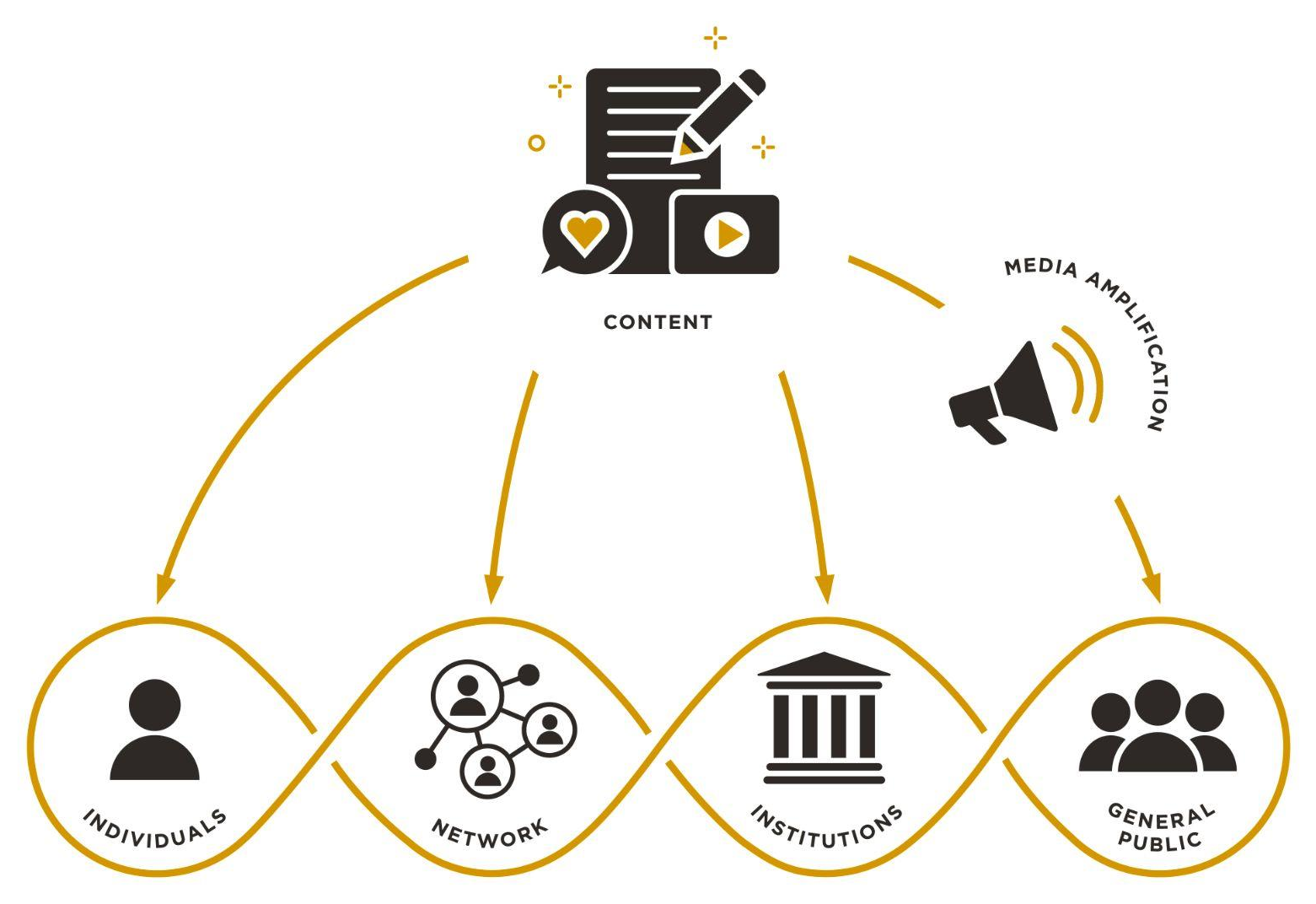
IA’s original Media Impact Model, 2017.
Our updated impact model — long overdue! — incorporates what we’ve learned and what we’re seeing. Namely, we’re creating space for the creative organizational activities we’re seeing, including engagement and intentional relationship building, in addition to content, all designed to catalyze change. Organizations are not only naming their desired outcomes, but also developing sophisticated workflows and strong organizational culture to measure and track these changes associated with their work, as well as adaptive organizational strategies and tactics to ensure effectiveness — and they’re considering this internal change to be impact, too. This dynamic process between organizational activities, outcomes, and learning is cyclical, rather than the old org-out broadcast model.
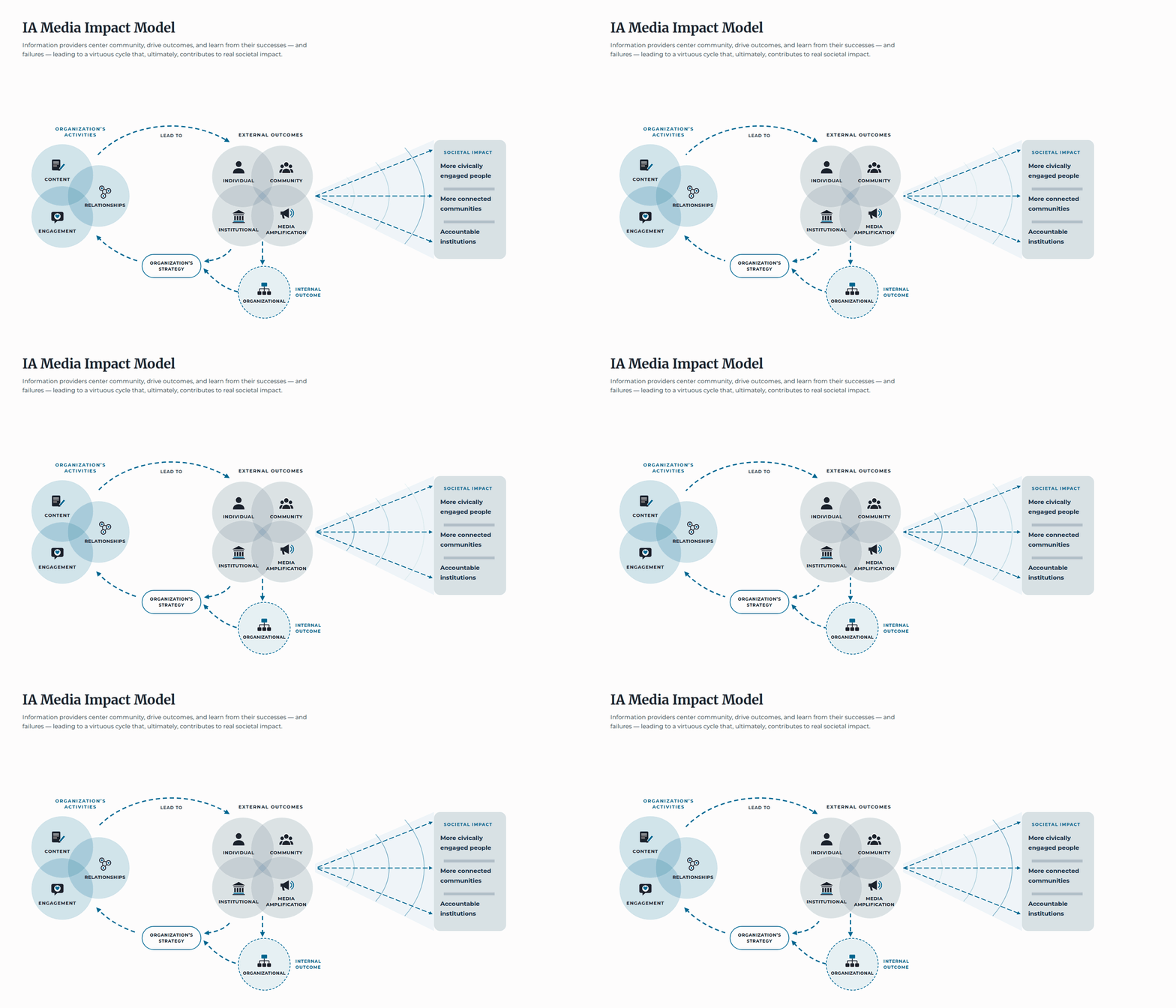
Over time, we’ve seen evidence that this virtuous cycle can contribute to broader societal impact, leading to more civically engaged individuals, more connected communities, and more accountable institutions. In research and in our experience, this holds true whether we’re talking about hyperlocal, state, regional, or national news.
This is happening at large for-profit organizations like Nation Media Group in East and Central Africa, premier investigative newsrooms like The Bureau of Investigative Journalism, single-issue nonprofits like Chalkbeat, and local nonprofit newsrooms finding new ways to serve their audiences, from Documented NY to Planet Detroit to El Tímpano in Oakland, CA. It’s worth noting that all of these organizations have invested in this work with dedicated staff working in roles like audience editors, impact producers, and community impact liaisons.
None of this is a given. It requires real work on the part of a newsroom to upend the deeply ingrained practice of reporting first and looking for impact later, to centering impact and building from there. Starting with impact requires newsrooms to understand their audiences, their connection to issues, and the questions they have. Organizations need to think broadly about the potential levers for change among not only institutions, but also individuals and communities. This context then guides the reporting process, from story choice to sourcing, and ultimately the content production and engagement activities coming out of the reporting to ensure the information gets to all critical stakeholders.
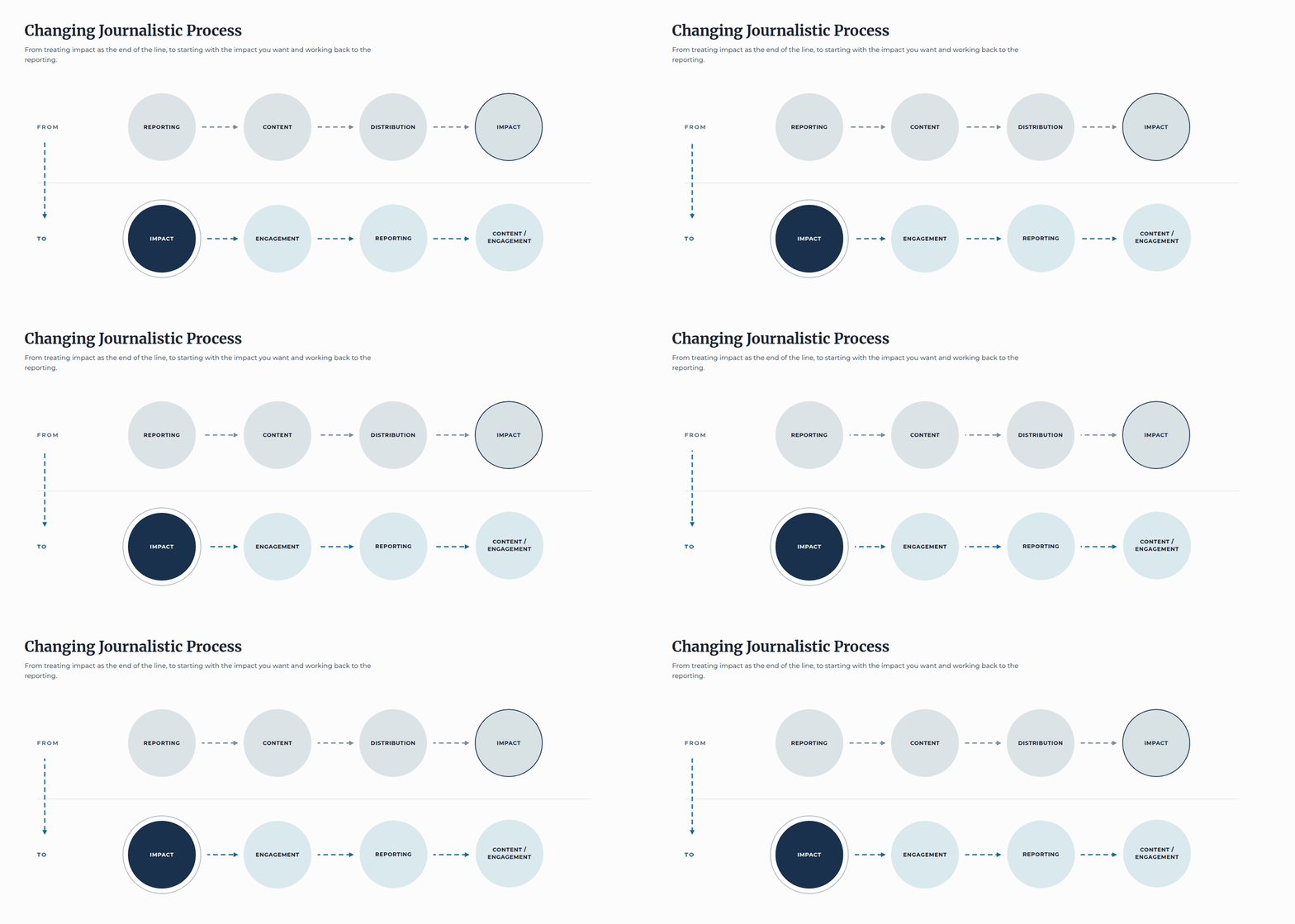
Let me be clear: I don’t believe that this shift in process changes the value of journalism. The skills and expertise that a journalist brings to the reporting process are possibly more important than at any previous point in history. If journalism is to play a role in our fast-evolving society, it must continue to adapt not only its reporting techniques, but its identity. This moment requires clarity of mission, centering communities and impact, and new custom-built strategies and tactics for reaching, informing, and engaging a variety of audiences to catalyze change.
Many newsrooms are somewhere in the messy middle, working to adapt organizational practices and cultures while also doing the work, day in and day out. If you’re interested in exploring these ideas or need support to apply what we’re learning in your organization, please reach out. And if you’re not sure where to get started, just head to the end and work backwards.
While we’ve learned a lot over the past decade-plus, these ideas aren’t new. Shout out to the OGs who were there at the beginning and who informed my thinking in ways that are impossible to measure, especially Cole Goins, Anika Anand, Ashley Alvarado, Annie Chabel, Caty Borum-Chattoo, Josh Stearns, Jennifer Brandel, Jessica Clark, Hannah Eaves, jesikah maria ross, Sarah Alvarez, Manami Kano, and Robert Rosenthal. And for all the work that’s gone into updating these frameworks at Impact Architects, gratitude to Rosemary D’Amour, Eric Garcia McKinley, Abigail Chang, and Hannah Stonebraker.