
Somewhere, sometime, I wrote “impact is a dirty word.” I think it might have been in my self-review at the Center for Investigative Reporting as my post-doctoral fellowship came to a close and I negotiated with my boss for a new — and different — role at the organization. My one demand? Take impact out of my job title. And so I had the opportunity to spend two (more) years as director of strategic research. Ahh, much better. (Clearly I got over the concern when I chose “Impact Architects” as my company’s name in 2017!)
That was in 2015, but here I am in 2026, and I find myself again in the position of, “don’t say the ‘I’ word.” But this time I mean infrastructure.
We’re in a moment of paradoxes. There is more philanthropic money going into local news and information than ever before (according to an internal analysis we did of Candid data). And, at the same time, there is more need than ever before as the field grows. The number of nonprofit news organizations, if Institute for Nonprofit News (INN) membership (an infrastructure organization?) is an indicator, at least doubled from 268 in 2020 to more than 500 in 2025. Local Independent Online News Publishers (LION) (also infrastructure?) has grown from 400 members in 2022 to nearly 600 in 2025. And with the closure of the Corporation for Public Broadcasting (infrastructure?), the 544 stations that were receiving grants have been left with budget gaps to close one way or another.
However, rather than cannibalize revenue, growth in the sector has instead been met with increased revenue for local news organizations across the country, according to our research as well as that published by INN, LION, and others.
But this is only part of the picture, as the number of journalism support organizations (JSOs) or intermediaries (another “I” word!) has also grown. The Journalism Support Exchange (JsX), a project of Press Forward and Commoner Co., is designed to be a one-stop directory of all JSOs, and currently has 369 organizations (infrastructure to manage infrastructure). Elizabeth Hanson Shapiro’s recent research surfaced infrastructure problems identified through Press Forward’s open call for proposals, and in its call for greater coordination and scaling across the sector, together with others like Dick Tofel, has set off alarm bells in JSOs hearing calls for consolidation.
But what is infrastructure?
I’m a sucker for definitions, not only because I’m a recovering academic, but because shared definitions and language are necessary for us to have field conversations together, rather than to be speaking above, below, and around one another.
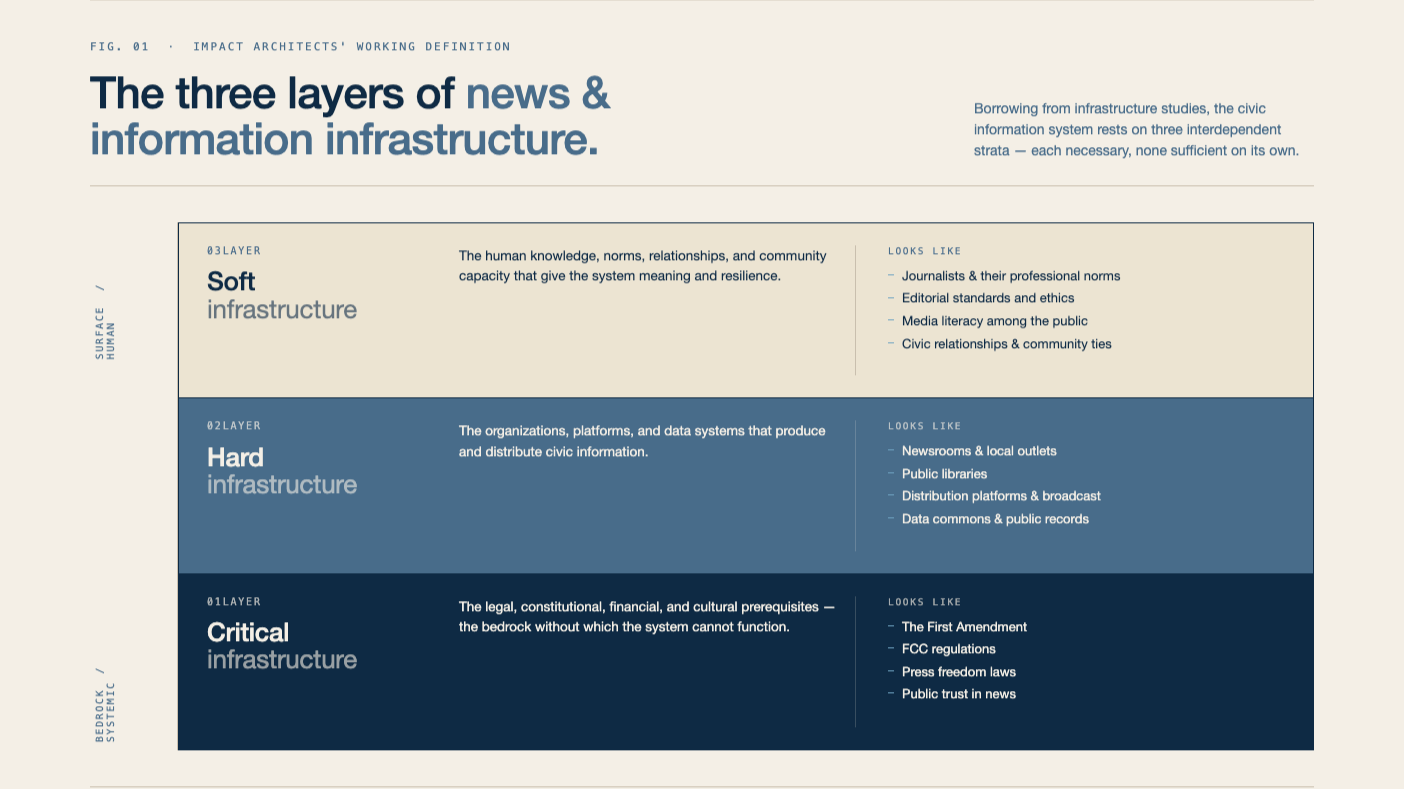
So I’ve been doing some research. Borrowing from infrastructure studies, I define “news and information infrastructure” in the following ways:
Critical infrastructure consists of the legal, constitutional, financial, and cultural prerequisites — the bedrock without which the system cannot function, such as the First Amendment, FCC regulations, press freedom laws, and general trust in news among the public.
Hard infrastructure includes the organizations, platforms, and data systems that produce and distribute civic information, such as newsrooms, public libraries, and data commons.
Soft infrastructure refers to the human knowledge, norms, relationships, and community capacity that give the system meaning and resilience, including journalists, professional norms, and media literacy among the public.
You might notice that JSOs aren’t explicitly categorized. That’s because they play a role in multiple places. JSOs, as organizations, are in the hard infrastructure category, but much of their programming aims to build capacity and skills in the “soft infrastructure” bucket. Newsrooms, concerned with being left out with all the focus on infrastructure, are also hard infrastructure. And their people — the pipeline — are their own kind of soft infrastructure.
But here’s what I’m most concerned about: critical infrastructure. Policies and regulation, sustained support, and general trust in news are prerequisites for all the rest. You can’t have airplanes, or airports, or pilots without an FAA. We can’t have the journalism we need without legal protections, public revenue sources, AI information integrity policy, and a public that sees the value in this work.
The critical infrastructure that is the bedrock everything else depends on, is the layer with the least funding and attention. To shore up existing critical infrastructure, and create the kind of proactive, forward-looking policy we need for the next information era, will require active engagement, organizing, and advocacy on the part of philanthropy, news organizations, intermediaries, and people.